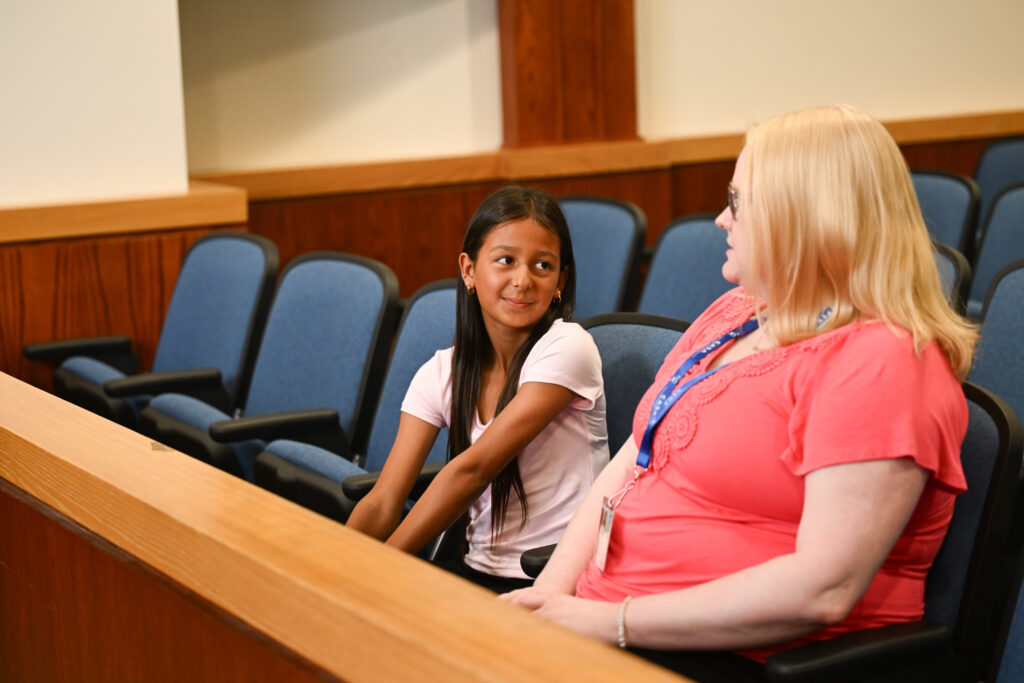
Court Appointed Special Advocates of Sacramento County is an independent nonprofit, but we are members of the National CASA/GAL Association and California CASA Association. Keep reading for answers to frequently asked questions about CASA.
What is a CASA’s role?
A Court Appointed Special Advocate (CASA) is a trained community volunteer who gets matched one-on-one with a child or young adult in the foster care or juvenile justice system. In an overloaded system where children in care are seen by their social worker once a month at best and attend dependency court only once every six months, CASA Volunteers provide the critical service of personalizing the child for the court. A social worker’s report may state merely that a child’s grades have fallen, while the CASA report will explain that the child switched schools and their classes did not transfer to the new school’s curriculum. This provides the court with a more well-rounded view of the child, and helps the judge approach the case from a strengths-based perspective.
What do CASAs do?
- Evaluate their assigned child’s circumstances and makes recommendations to the Juvenile Court about the child’s needs such as placement, reunification, sibling visits, and referrals for health services.
- Review and evaluate the child’s educational performance and, where appropriate, initiate testing to determine whether additional services to improve academic performance are warranted. The CASA follows up to confirm that agreed-upon services are offered and completed and attends hearings related to educational needs.
- Identify friends and relatives who can be permanent connections for these children so that they can have a network of support after leaving the child welfare system.
- Help prepare older youth for emancipation from foster care by engaging them in Independent Living Services and assist them in obtaining information about vocational training, college admissions, general employment and transitional housing.
- Transport the child to activities and court hearings where appropriate.
- Offer new and exciting experiences to the child such as dining out, visiting museums, music shows, and sporting events. (costs covered by volunteer or donated to program)
- Celebrate birthdays and special moments, giving each child precious memories.
- Provide a voice in court, a friend and mentor, and an advocate for a better life.
Why are CASAs volunteers?
A CASA Volunteer is often the only consistent adult in a foster or justice-involved youth’s life who isn’t paid to spend time with them. The volunteer role allows CASAs to prioritize the best interests of the child they serve, without being beholden to any other parties to the case. When children and youth learn that their CASA is a volunteer, it helps establish trust because they understand that the CASA is there because they want to be.
Who are the children represented by CASA volunteers?
CASA Sacramento serves children and youth ages 0-20 in Sacramento County’s foster care and juvenile justice systems. Youth are referred to the CASA program when they are struggling in the system and need extra support of a one-on-one match with a CASA Volunteer. CASA Volunteers represent -re-school to adolescent children in foster care who have typically been removed from their homes following allegations of parental abuse or neglect. Many justice-involved youth were in foster care before they crossed over into the juvenile justice system.
How does a CASA volunteer investigate a case?
To prepare a recommendation, the CASA Volunteer talks with the child, relatives, social workers, school officials, health providers and others who are knowledgeable about the child’s history and current circumstances. The volunteer also reviews all reports and records pertaining to the child.
How does the role of a CASA volunteer differ from a social worker?
The CASA Volunteer does not replace a child’s social worker. However, because the CASA Volunteer only serves one or two youth at a time, they can often conduct a more comprehensive investigation than a county social worker, who may be assigned 50 or more cases. The one-on-one mentor relationship between a CASA Volunteer and the youth they serve allows them to build a consistent, trusting bond, providing the CASA with deeper insight into the youth’s needs.
How does the role of a CASA volunteer differ from an attorney?
The CASA Volunteer does not provide legal representation. However, the volunteer does provide crucial background information that assists attorneys in presenting their cases.
Are CASA programs effective?
Yes! The National CASA Association has found that a foster child with an advocate has a better chance of staying connected to siblings, completing high school, and attending college. Children with a CASA Volunteer are more likely to be adopted, spend less time in care, and are less likely to fall victim to drugs, violence and trafficking. One year of CASA advocacy costs less than one month of foster care, and a youth with a CASA Volunteer is less likely to require public assistance or be incarcerated as an adult.
How does the CASA volunteer relate to the child they represent?
CASA Volunteers offer children trust and advocacy during complex legal proceedings. They help the child understand what events are happening, the reasons they are all in court and the roles that the judge, lawyers and social workers play. While remaining objective observers, CASA Volunteers also encourage the child to express their own opinion and hopes. Though CASA Volunteers do not represent a child’s wishes in court, they tell the court what the child’s wishes are. Then they exercise their own independent judgment to determine whether those wishes are actually in the best interest of the child.
Is there a “typical” profile of a CASA volunteer?
CASA Volunteers are community members from all walks of life with a variety of educational and ethnic backgrounds. There are more than 79,000 CASA Volunteers nationally who serve 214,000 children per year. The majority of CASA Volunteers are working or retired professionals. CASA Sacramento is always working to recruit a volunteer base that better reflects the youth we serve: we need more male volunteers, more volunteers of color, and more LGBTQ+ volunteers.
How much volunteer time is required?
Each case is different, but volunteers typically work about 15–20 hours each month, sometimes longer when a case is at a critical stage. Ideally, the volunteer continues on a case until it is permanently resolved, because one of the key goals of the CASA program is to provide continuity in the child’s life. We ask volunteers to make a minimum 18-month commitment to the program.
Does CASA offer other programs that serve foster youth?
Juvenile Justice
While CASA advocacy has centered primarily on the overall well-being of youth in the dependency system, CASA Volunteers are more frequently having to advocate for youth in Juvenile Justice Court. Much like the dependency system, the juvenile justice system is difficult to navigate; accessing care, coordinating services, and participating in Juvenile Justice Court hearings are even more challenging when a youth is criminalized. CASA Volunteers can have a positive impact on recidivism and reduce the likelihood of their youth coming into contact with law enforcement by providing a consistent, positive adult in their life and ensuring they have access to services.
Making Memories
Making Memories is a program of CASA Sacramento which provides special experiences to foster children who otherwise would not have the resources to pay for them. Foster parents receive financial support for a basic standard of living including providing a room, furniture, clothing, food, hygiene products and replacements for lost backpacks, broken eye glasses and other essentials. Basketball or theater camp has typically never been an option, especially for children who have moved many times and been through many homes. Extracurricular activities help children and young adults learn social skills, build confidence and provide the relief of getting to be a young person among peers. Making Memories funds approximately 50-70 individual foster youth extracurricular activities annually.
How is CASA funded?
CASA receives funds through a variety of private and public sources. CASA Sacramento’s funding comes from donations and fundraising events (55%), program grants and government contracts (41%), and the remaining 4% comes from the Superior Court of Sacramento County – cash and in-kind facilities donation of office space, which includes offices for 18 staff and a training room for CASA Sacramento to provide initial training and continuing education for new CASA Volunteers. Our Sustainability Plan was reviewed and certified in 2020 by the Impact Foundry and our goal to secure 90 days of operating reserves has been surpassed.